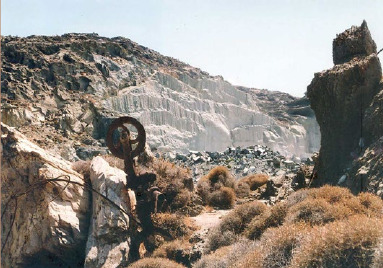
Although mining has been prevalent in the region since antiquity, mineral extraction intensified and diversified across the nineteenth and twentieth centuries, drawing thousands of workers to the islands and reshaping their harbours, roads, and settlements. What remains today is a scattered infrastructure of galleries, loading bridges, washing plants, and abandoned company towns – a landscape that is at once industrial ruin and living memory.
Working across Tinos, Serifos, and Milos, the project combines archival research, oral history, and field photography to trace how extraction moved through the Cyclades. Company ledgers, geological surveys, and family photographs are read alongside the testimony of former miners and their descendants, building a picture that is technical and intimate in equal measure.
A digital archive of extraction
At the heart of the project is an open, searchable archive. Each site is documented with high-resolution imagery, historical maps, and annotated timelines, allowing visitors to move between the geological, the economic, and the personal. The archive is designed to grow: researchers, residents, and institutions are invited to contribute materials and corrections.
By placing these fragments in dialogue, Digital Traces asks what it means to inherit an extracted landscape – and how the stories of labour struggle, technological ambition, and environmental cost might inform the way these islands imagine their future.